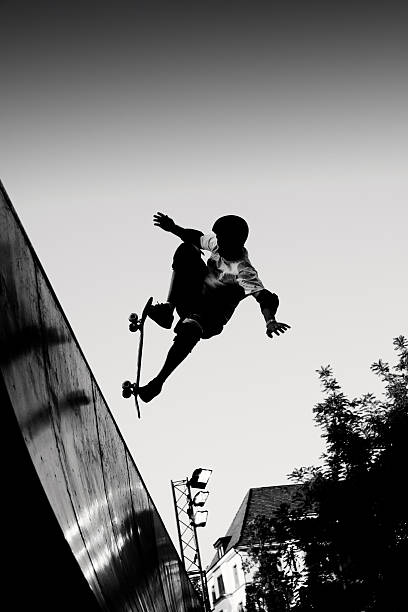
There are athletes who have everything — talent, discipline, the right moment — and still disappear. Not because they give up. Not because they fail. But because the system spits them out before they can prove what they are made of. Lee Ralph is one of those athletes.
The New Zealander was one of the most exciting skateboarders in the world in the late 1980s. No exaggeration. He skated against Tony Hawk, Christian Hosoi and Steve Caballero — the gods of the sport. And he kept up. At his first competition in America he finished sixth. That never happens. Nobody had ever done that before.
Lee Ralph · Scratched: Aotearoa's Lost Sporting Legends · The Spinoff, 2021
The Body as an Instrument of Obsession
What fascinates me about Lee Ralph is not the tragedy. It is the way he trained. Straight edge — no alcohol, no drugs, nothing. While other pros smoked and drank, he was on the ramp. Hour after hour. He describes it like this:
"The time they spend doing that — I'm hammering at the ramp. I'm getting better and better and better. Sometimes I'm riding and just going: somebody stop me. Because I'm on fire." — Lee Ralph
This is not a quote about skateboarding. It is a quote about the psychology of peak performance. Someone who talks about their training like this has understood what most people never understand: the others party, you work. That is the difference. Not talent. Not luck. Decisions.
"It's all I think about. 24 hours a day."
When someone talks about their sport like this, we are no longer talking about a hobby or a career. We are talking about identity. The sport is not what he does — it is who he is. That makes him unstoppable. And it makes him vulnerable.
What a Visa Can Do to a Life
The story of his end is absurd and mundane at the same time. Lee Ralph had no green card. As an amateur in America he was not allowed to earn money. He went to Paris for a demonstration event — came back — and was deported. At 19 years old. At the peak of his career.
His sponsor Vision could have sorted it out. Could have. He himself says he could have sorted it out. He did not — because that is not "how he rolls". Because a person who thinks about nothing but his sport 24 hours a day does not simultaneously think about bureaucracy. That is not an excuse. It is a portrait.
"My whole life had been aiming at it. Everything was on. Nothing could stop it. Then I went to Paris." — Lee Ralph
The Essence of Sport — and Who Still Lives It
There is a question this story will not let go of: when did an athlete stop playing for the sport — and start treating it as a job?
Lee Ralph is one extreme end of that spectrum. Someone so completely consumed by the essence that he simply forgets the framework around it. No green card. No plan B. Just skateboarding. And that is precisely what made him great — and what brought him down when the framework collapsed.
The maniacs, the artists, those who burn for a single thing — they do not care about the frame. And that is exactly what makes them unforgettable.
But when I look at professional sport today — in football, tennis, basketball — I increasingly see the other end. Players who sit on the bench and do not care whether they play. Who get their money and are content with that. The love of the game, the burning for the essence — it is gone. Lost somewhere on the way to the top.
Who Really Makes It to the Top
Many people believe world stars become world stars because of money, management, the right support structure. That is true — but it is not the origin. The ones who actually get there, almost without exception: they are the Lee Ralph types. Who are eleven years old and think: I will be the best in a few years. Not because they are arrogant. But because they have no brain capacity left for anything else.
Cristiano Ronaldo sleeps in a compression vest and trains on Christmas Day. Not for the money — he has had that for years. He does it because he cannot do otherwise. Because the essence drives him, not the framework. That is the difference between someone who plays football and someone who is football.
How Many Lee Ralphs Are Out There?
That is the question that occupies me most. Not the tragedy of Lee Ralph himself — that happened, he has made his peace with it. But the systemic question behind it: how many talents are disappearing right now because they do not care about the framework — only about the actual thing?
The modern sport has a perfect filter for exactly one type of person: the organised, disciplined, media-compatible and commercially viable one. Those who pass this filter rise to the top. Those who do not — disappear. Even if they are the better ones.
How many talents are out there who go unrecognised — because they only care about the actual thing?
What Remains
I have worked with athletes for over 20 years. Big and small, famous and forgotten. The most important distinction I have made in that time is not between talent and non-talent. It is between people who live for their essence — and those who use their sport as a vehicle.
Lee Ralph was the former. Uncompromisingly. To the point of self-endangerment. That made him great. It also let him fall when the framework broke apart.
And then — this is what is extraordinary — he finds himself again. Not on the ramp. On a farm in Taranaki, New Zealand. He laughs at himself, gets electrocuted by a fence, plays guitar, has made his peace. "No regrets" he says.
Lee Ralph never won the world championship. He is a world champion nonetheless. In the only discipline that matters: he did not betray himself. And that — thirty years later — is why we are still talking about him.